

授業のワンポイント
親しい人への依頼/週末の天気予報
■題材導入と Listening 活動Step 1(p.15)
(1)教師とALTが依頼のやり取りをデモンストレーションします。生徒は閉本状態で,デモンストレーションを見ます。
【会話例】
T: Today, we will learn how to ask our friends, family, or someone close to us to do what we want them to do. In short, saying: “Please do this for me!” casually.
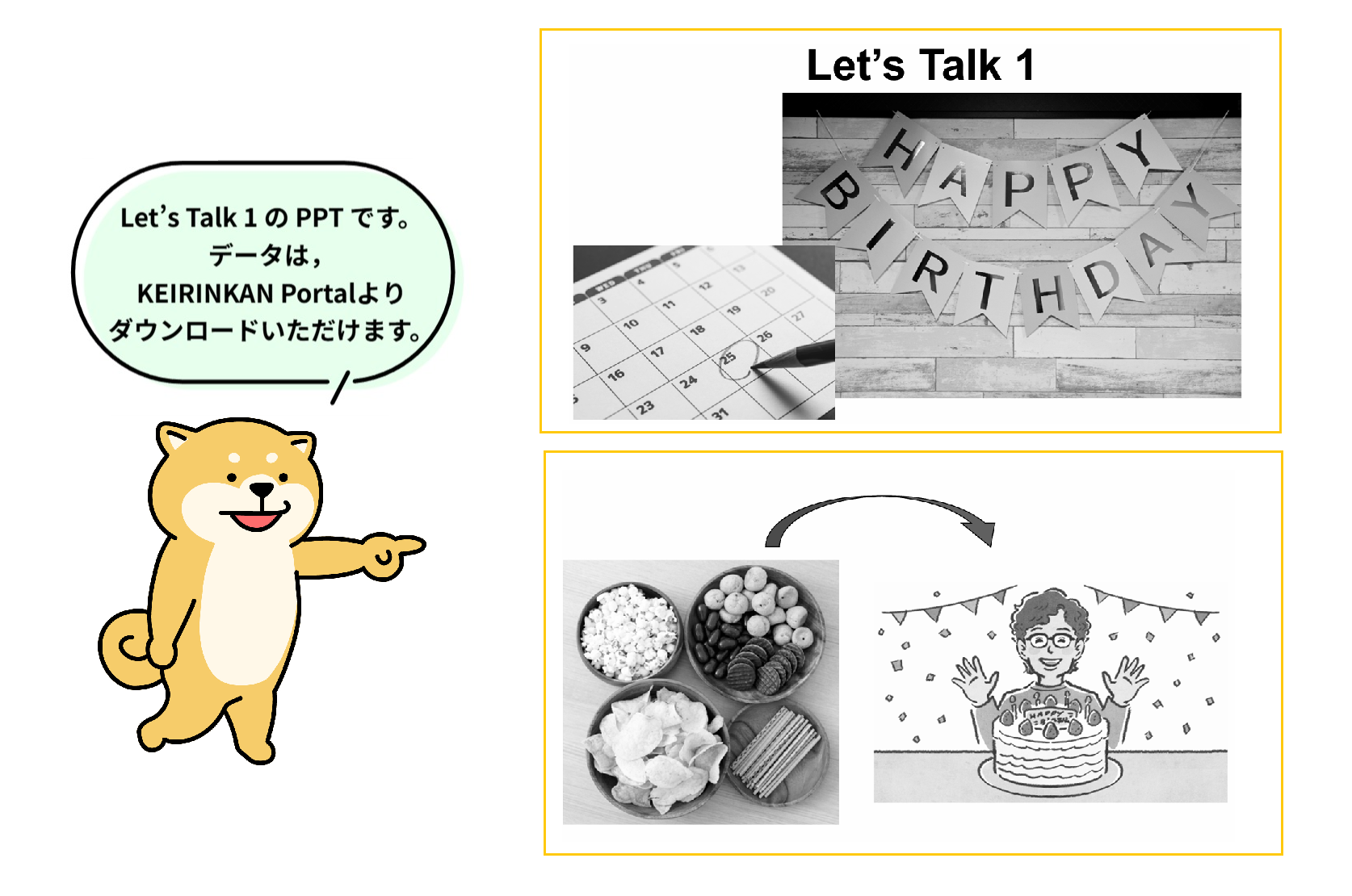
(PPT 1枚目の誕生日パーティーの写真を提示します。)
T: It will soon be Mike's birthday.
Mike hosted my birthday party last month, so I'll be the one to prepare for him this time!
But I need someone to help me with....
Oh, hi, Sam!
ALT: Hi, Erika.
What's up?
You look troubled.
(ここまではアドリブ。以降は,教科書p.15のモデル会話を読み上げます。)
T: Do you have any plans for next Sunday?
ALT: Not really.
T: I'm going to have a birthday party for Mike.
Can you come?
ALT: Of course.
T: Good. Will you bring some snacks?
(PPT 2枚目のsnacksの写真を提示します。)
ALT: Sure.
(以降もアドリブを続けます。)
T: Thank you so much!
ALT: You're welcome.
・ALTがいない場合は,生徒に1人ボランティアを募り,デモンストレーションをします。
(2)やり取りの内容についてQ&Aを行う。
・PPTのスライドを再度提示しながら質問するとよいでしょう。
【会話例】
T: Now, class, please answer my questions.
Question 1.
What is Erika, or Erika and Sam going to have next Sunday?
S2: Have a birthday party for Mike.
T: Good. Question 2.
What does Erika ask Sam to do?
S3: Bring some snacks.
T: Right. Question 3.
What is Sam’s answer?
“Yes” or “no”?
S4: Yes.
T: Nice! Now, we have some useful words and expressions.
Please repeat them after me.
“Will you bring some snacks?” “Of course.” “Sure.”
(1文ずつリピートします。)
T: Let's check out today's topic and expressions.
Open your textbook to page 15.
■Key Expressions の解説p.15
ここでは,してほしいことを親しい相手に依頼する Will you ~ ? を使った文の文構造と意味,使い方や,依頼を承諾したり断ったりする表現を学習します。
(例)
① Will you bring some snacks?
(お菓子を持ってきてくれませんか。)
② Sure. / Sorry, I can't.
(もちろんです。/すみませんが,できません。)
〔形式〕
・助動詞 will は①のように Will you ~ ? の疑問文の形で依頼の表現として用いられます。
・助動詞 will の後は動詞の原形が置かれます。助動詞 will の肯定文,否定文,疑問文,応答文は Target 1 で学習済みです。
〔機能と意味〕
・①は「お菓子を持ってきてくれませんか。」という意味。
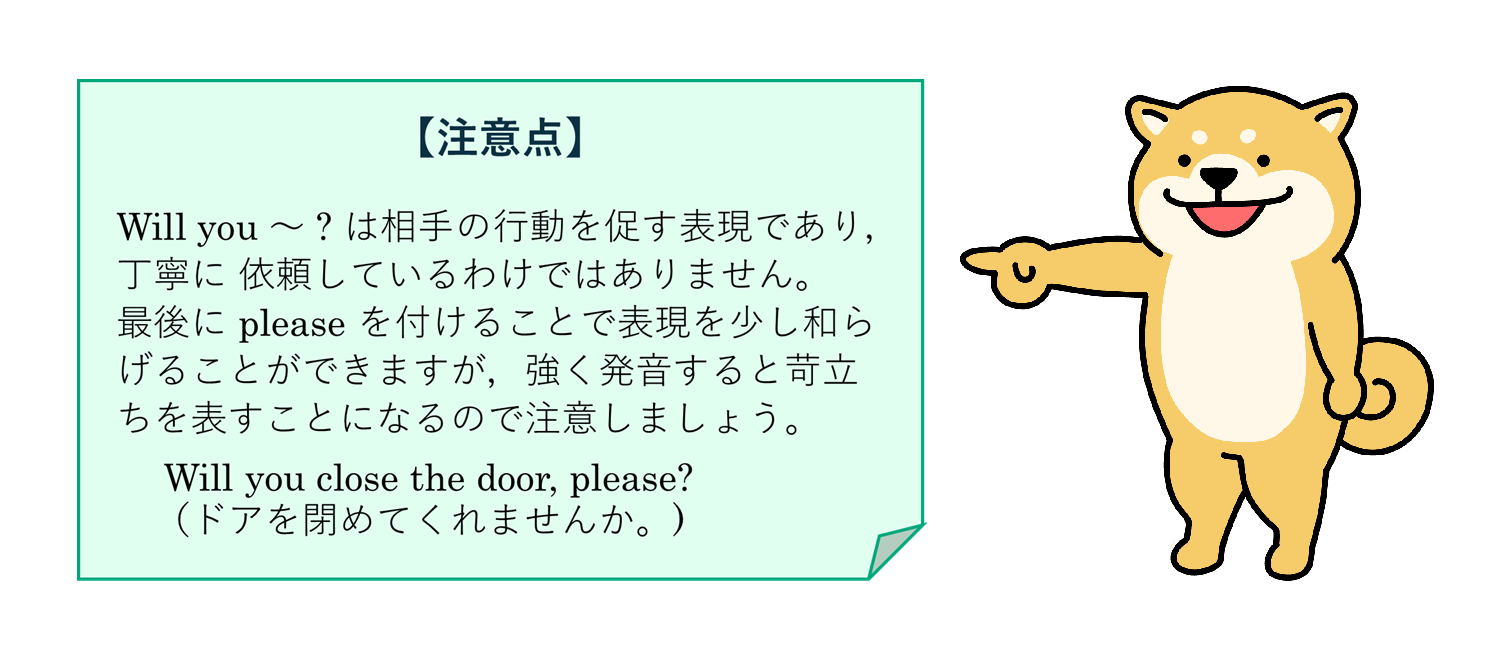
・依頼の Will you ~ ?は「~してくれませんか」という意味。日本語では丁寧な表現のように聞こえますが,丁寧度はやや低いため,親しい人に依頼するときや,職場で上司が仕事を依頼・指示するときなどに用いられます。
・②は依頼に対する応答の表現。依頼を受け入れる場合は,Sure. や All right. などを用い,そうでない場合は Sorry, I can't. などと,申し訳ない気持ちを表してから断ります。
・意志や予測を表す助動詞 will は Target 1 で学習済みです。
■Writing & Speaking 活動Step 3(p.15)
(1)Tool Box 内の語句や表現を全体で確認します。
【発話例】
T: Let's make our skits.
Look at the Tool Box in Step 3.
There are some useful expressions for the skits.
Please repeat after me.
(1つずつ発音と意味を確認します。)
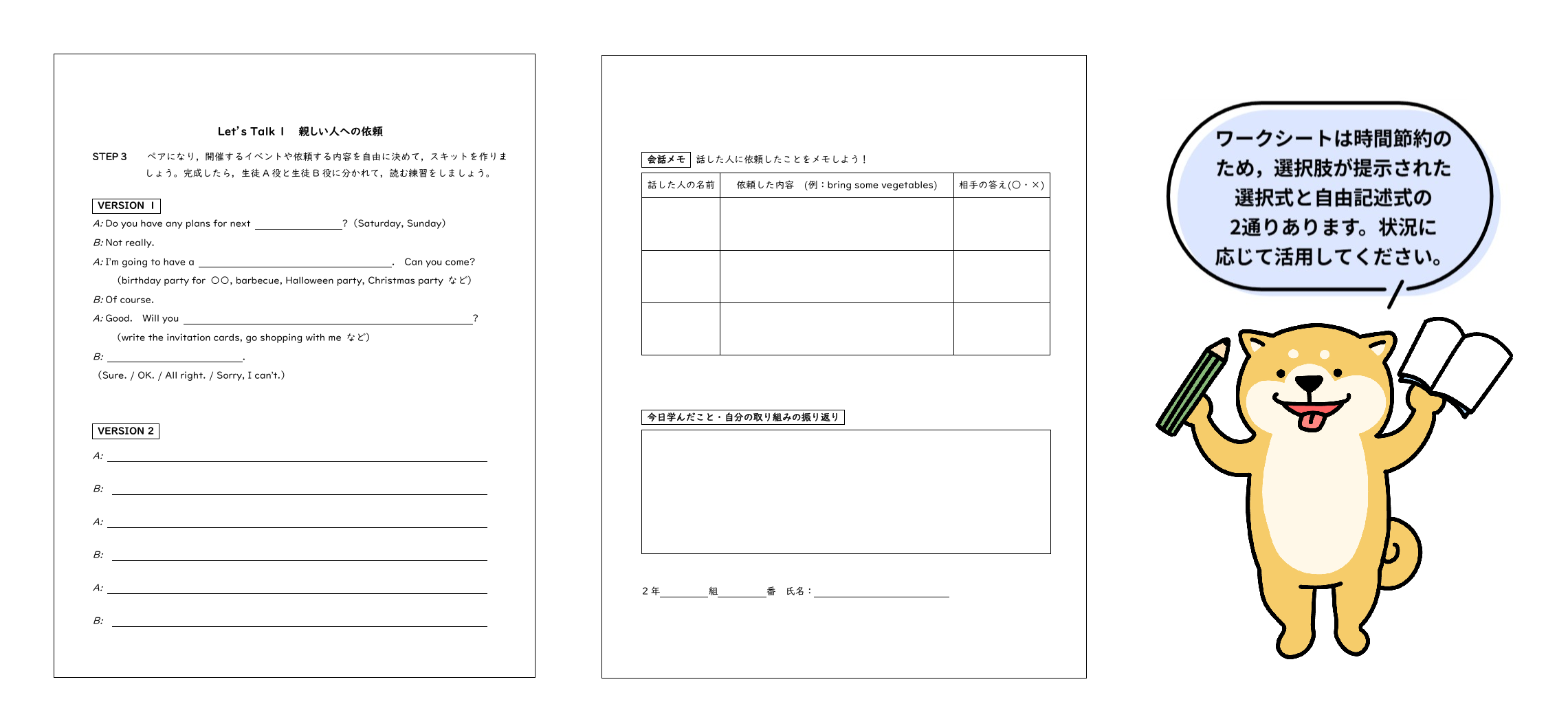
(2)ワークシートを配布し,ペアでスキットを作成します。
・生徒がスキットを作成中は,教師は机間巡視して生徒をサポートしましょう。
・ほかにも,会話のパターンに入りそうなイベントや準備のアイデアを出し合ってから,活動に入ってもよいでしょう。
(例:New Year's party, welcome party, wedding, party, wedding reception, year-end party, farewell party, graduation party, hanami party, house party など。)
【会話例】
T: What other parties do you come up with?
Do you have any other ideas about parties?
S1: A New Year's party.
(教師は板書します。)
T: Right. What else?
S2: Welcome party.
S3: Hanami.
T: Great. What do you need to do for the party?
S4: Message my friends.
S5: Get a place.
(同様に,イベントや必要な準備を挙げます。)
T: Thank you so much for your wonderful ideas.
Of course, you can write your skits using these original ideas that are not in the textbook.
Now, please start writing a skit with your partner.
Don't forget to use “Will you ~ ?” in your skits.
You have six minutes to complete your writing.
(ペアでスキットを作成します。)
T: Time is up.
Please practice reading the skit with your partner together.
(スキットを読む練習をします。)
・いくつかのペアを指名して,スキットを読み上げてもらってもよいでしょう。発表者のスキットの内容をよく聞くように,聞き手の生徒に,内容に関する質問をしてもよいでしょう。
(3)即興でのスピーキングに挑戦します。
パーティーの準備で必要なことを,2つほど考えて,相手に依頼するやり取りをします。依頼される側は,承諾する場合と断る場合の両方のパターンをやってみます。
■Listening 活動Step 1(p.16)
(1)Step 1 の問題指示文と解答方法を確認します。
(2)教師は,デジ教で音声を2回聞かせ,問題に取り組ませます。その後,ペアになって答え合わせをします。
その後,新出語句の導入をした後,必要に応じて,再度 Step 1に取り組みます。
Step 1で問われる情報以外の詳細について聞き取り,生徒とやり取りをしながら内容を確認します。教師は,デジ教で音声を2回聞かせ,生徒にメモを取らせます。教師は次のポイントを口頭か板書して示します。
・What activities can you do on Saturday? Why?
・How hot is it on Saturday?
・How hot is it on Sunday?
・When will it start raining?
・Will the storm stop at night?
【会話例】
T: Check the answers to these questions.
(ペアになって,答え合わせをします。)
T: What activities can you do on Saturday?
S1: We can do outdoor activities.
T: For example?
S2: Camping?
T: Good. Anything else?
S3: Cycling?
T: Good examples.
Mountains or rivers are not all you can do on a fine day.
Can you talk with your partner about what activities you can do on a sunny day?
(ペアになって話し合います。)
T: Give us your ideas.
S4: We can play sports like soccer or baseball outside.
T: Right. You can go to a park to play some sports with your friends.
What else?
S5: I want to ride the merry-go-round, teacups, and roller coasters in ...
T: In an amusement park. Good.
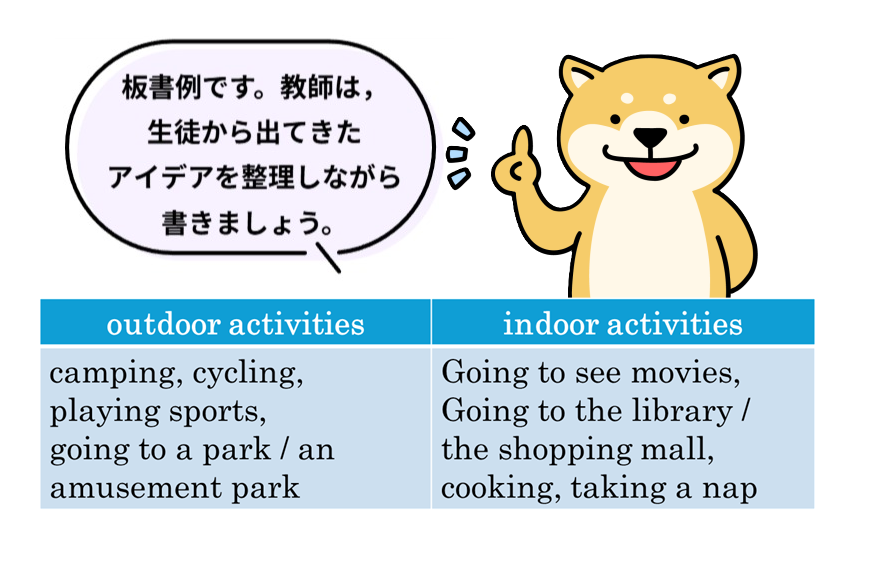
(教師は出てきたアイデアを板書する。)
T: How about indoor activities?
How many indoor activities can you think of with your partner?
(ペアになって話し合う。)
T: What are your ideas?
(教師は出てきたアイデアを板書する。
T: All right.
Let's go back to the first question.
Why are outdoor activities good on Saturday?
S: ...
T: Listen to that part again.
(デジ教で音声を聞かせます。必要に応じて,解答の部分で止めて繰り返し聞かせます。)
S6: It'll be sunny all day.
It's warm with a high of 25, a low of 21.
T: You covered the second question, too.
Good job.
(教師と生徒でやり取りしながら答え合わせをします。)
【Let's Talk 1】親しい人への依頼
【Let's Listen 1】週末の天気予報
(教科書p.15~16)
アンケート
よろしければ記事についてのご意見をお聞かせください。
Q1またはQ3のいずれか一方はご入力ください。